

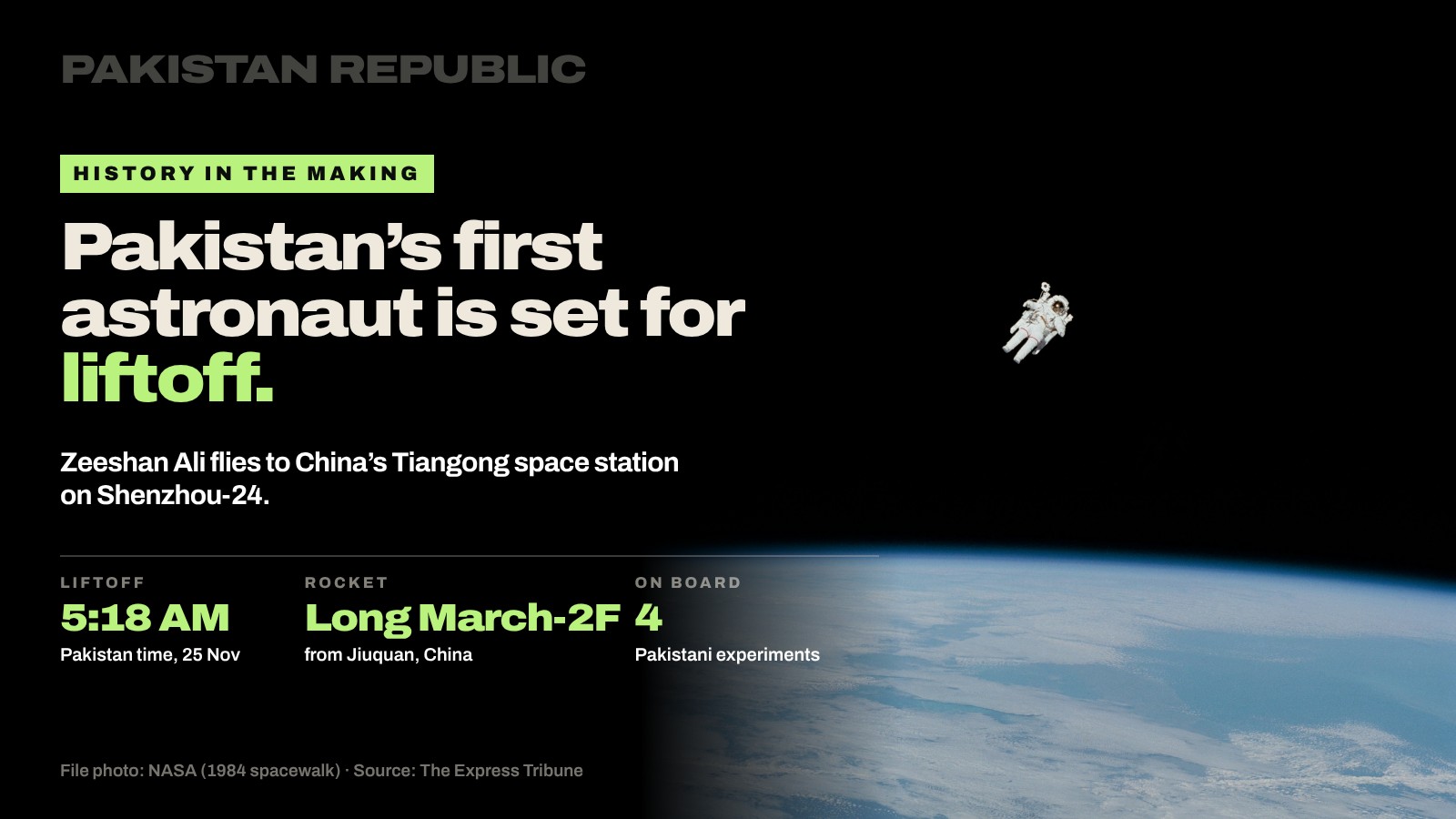
Zeeshan Ali to fly as Pakistan's first astronaut on Shenzhou-24
The China Manned Space Agency named the crew at a Tuesday press conference. Launch from Jiuquan is scheduled for 5.18am Pakistan time on 25 November, with four Pakistani experiments on board.
Key points
- The China Manned Space Agency named Muhammad Zeeshan Ali as payload specialist on Shenzhou-24, alongside commander Tang Hongbo and flight engineer Wu Yi.
- Launch is scheduled for 8.18am Beijing time, 5.18am Pakistan time, on 25 November from the Jiuquan Satellite Launch Centre.
- Ali will run Pakistan's scientific programme of four experiments at China's Tiangong space station.
- The mission had not launched at the time of writing.
Muhammad Zeeshan Ali is set to become Pakistan's first astronaut in space if the flight goes ahead as planned. The China Manned Space Agency (CMSA) announced him on Tuesday, at a press conference, as a payload specialist on the Shenzhou-24 mission to China's Tiangong space station. Liftoff is scheduled for 5.18am Pakistan time (8.18am Beijing time) on 25 November, according to The Express Tribune. The mission had not launched at the time of writing.
Crew and mission
The CMSA announced the three-member crew at the Jiuquan Satellite Launch Centre in north-western China. Ali will fly with commander Tang Hongbo and flight engineer Wu Yi. A Long March-2F rocket will carry the spacecraft.
The mission is led by the CMSA in partnership with Pakistan's space agency, SUPARCO.
According to Chinese authorities, cited by The Express Tribune, Shenzhou-24 is the 41st mission of China's crewed space programme. It is also the eighth crewed mission during the development and operational phase of the space station.
Pakistan's experiments
Ali's main task is to carry out Pakistan's research programme in microgravity. The Tribune said the programme was developed by Pakistani researchers. It covers materials science, fluid physics, life sciences and biotechnology. It includes four experiments, three of which will be installed on the station's external experimental modules.
- Microalgae cultivation in "green micro-factories", as a possible source of nutrients and oxygen on long missions.
- A study of how microgravity and cosmic radiation affect quinoa seed longevity.
- A test of microcapsule-based self-healing composite materials.
- An evaluation of hybrid composites under vacuum, radiation and extreme temperatures.
The last three will stay on the external modules, exposed to the space environment, for one year. The programme is being undertaken with Chinese support, in collaboration with the Centre for Space Utilisation, Shanghai Institute of Technical Physics, Dalian Maritime University and Shanghai Jiao Tong University.
Ali's message
Speaking to the media at the launch centre, Ali called his selection an honour for Pakistan. He said he was carrying "the hopes of 250 million Pakistanis". He added that what followed the flight would matter more than the journey itself. He also thanked the Chinese staff for his training.
Tiangong orbits about 400 kilometres above Earth. It has three modules: Tianhe, Wentian and Mengtian. China completed its basic three-module configuration in November 2022.
Until the launch is confirmed, Ali's flight remains planned rather than completed.
Sources
- Zeeshan Ali to be Pakistan's first astronaut in space aboard Shenzhou-24 — The Express Tribune, 2026-11-24
How this story was made
Researched and written by the Pakistan Republic AI newsroom from the sources listed above, then checked against them before publishing. Stories about people, politics, courts or crime are also reviewed by an editor.